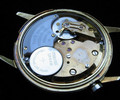
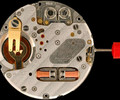
Mechanical movements watches
Mechanical watches are often less accurate than electronical movements, but they still have a large success
| Rating: 53 %1000 with 276 votes |
 Yes 1 Not so much 0

- Summary
Compared to electronic movements, mechanical watches are less accurate, often with errors of seconds per day, and they are sensitive to position and temperature. As well, they are costly to produce, they require regular maintenance and adjustment, and they are more prone to failure. Nevertheless, the "old world" craftsmanship of mechanical watches still attracts interest from part of the watch-buying public.
Mechanical movements use an escapement mechanism to control and limit the unwinding of the spring, converting what would otherwise be a simple unwinding, into a controlled and periodic energy release. Mechanical movements also use a balance wheel together with the balance spring (also known as a hairspring) to control motion of the gear system of the watch in a manner analogous to the pendulum of a pendulum clock.
The tourbillon, an optional part for mechanical movements, is a rotating frame for the escapement which is used to cancel out or reduce the effects of bias to the timekeeping of gravitational origin. Due to the complexity designing a tourbillon, they are very expensive, and only found in "prestige" watches. The pin-lever (also called Roskopf movement after its inventor, Georges Frederic Roskopf), is a cheaper version of the fully levered movement which was manufactured in huge quantities by many Swiss manufacturers as well as Timex, until it was replaced by quartz movements.
Tuning fork watches use a type of electromechanical movements. Introduced by Bulova in 1960, they use a tuning fork at a precise frequency (most often 360 hertz) to drive a mechanical watch. The task of converting electronically pulsed fork vibration into rotary movement is done via two tiny jeweled fingers, called pawls. Tuning fork watches were rendered obsolete when electronic quartz watches were developed, because quartz watches were cheaper to produce and even more accurate.
Source: Watch wikipedia


 |